Sparkwell Kids

Lab Cards for grown-ups

Free one-page printables for each episode of Kitchen Science with Mabby & Lid. Print a card, gather the things on the list, and do the experiment together. Every card has a Grown-Up Check box. Please read it before you start.

E01 · Will It Float, Lid?

The question: Does big mean sink? (Season 1, Episode 1)
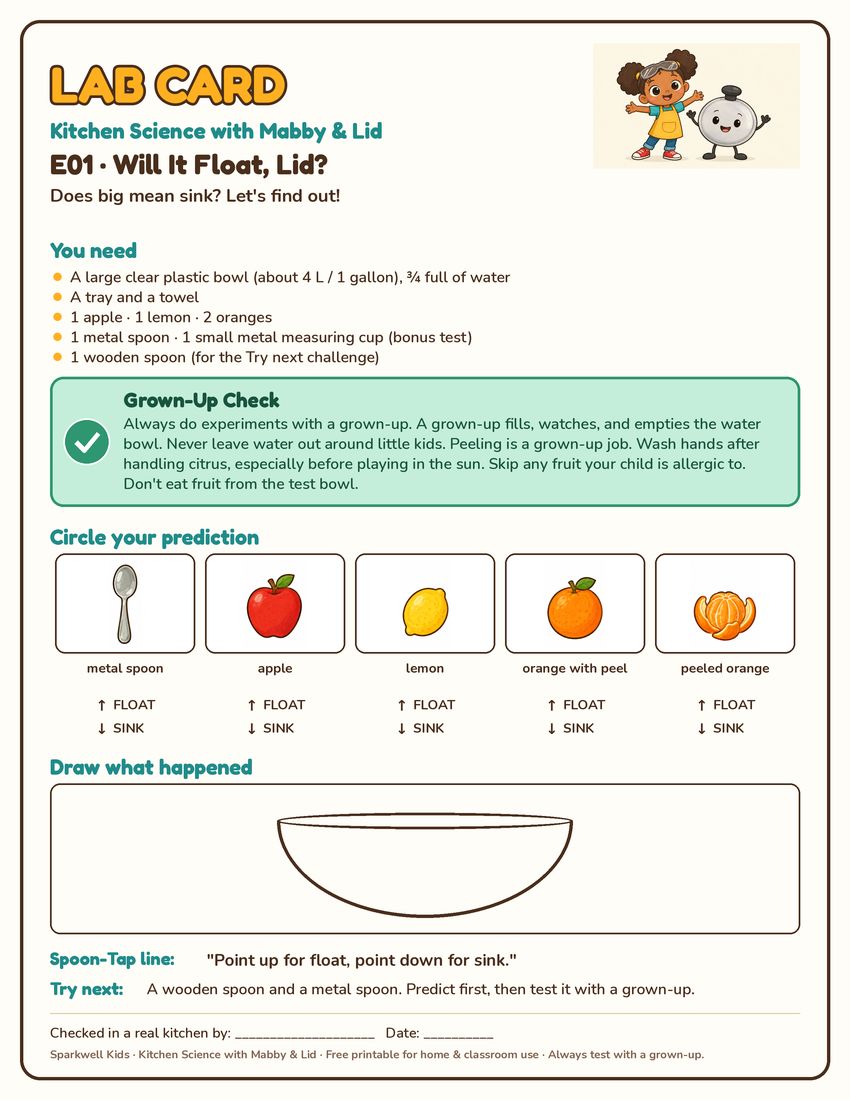
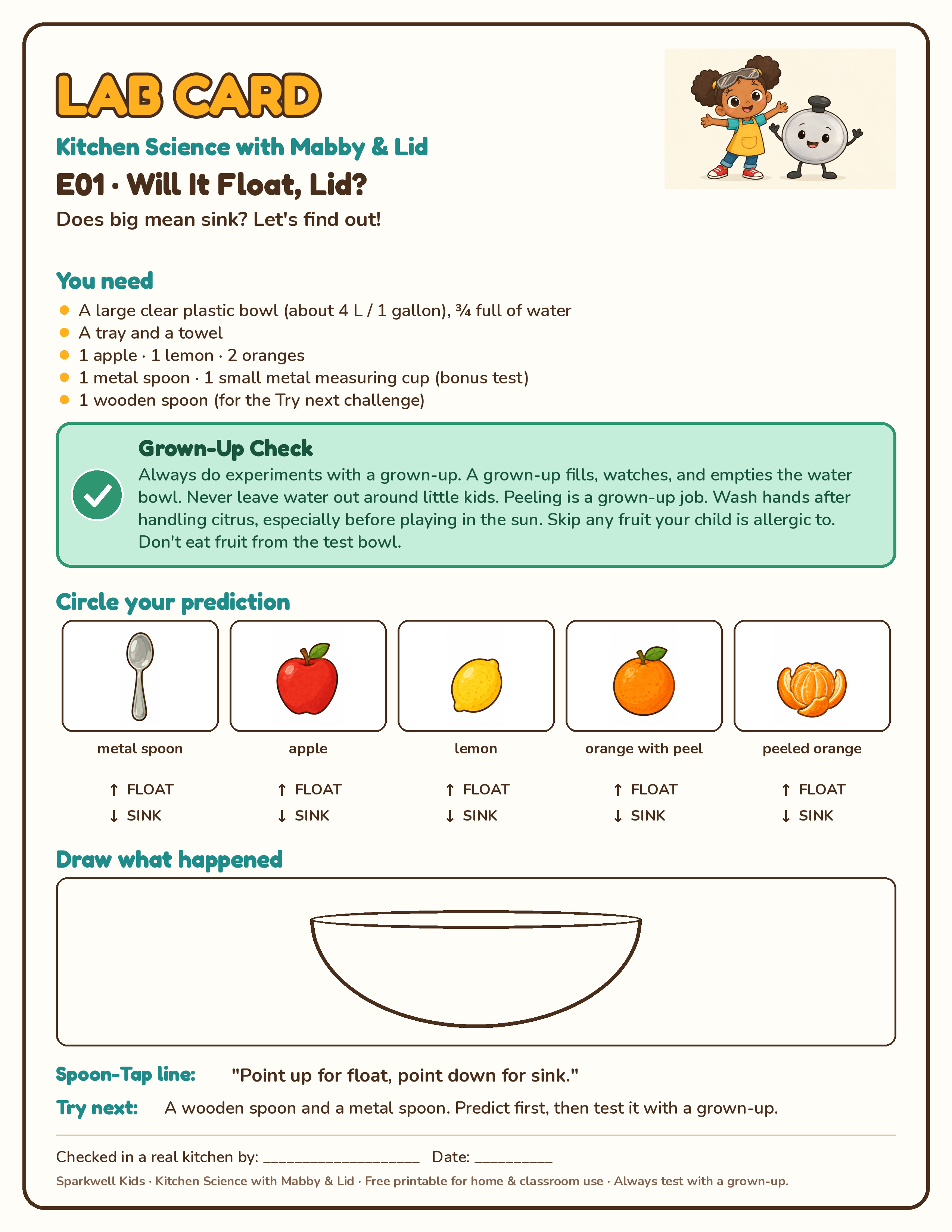
Preview of the E01 Lab Card, Will It Float, Lid?: a one-page printable with a You need list, a Grown-Up Check box, a prediction to circle and a space to draw what happened.
Preview of the one-page card (US Letter).

Download PDF Full-size image

What you need

  • A large clear plastic bowl (about 4 L / 1 gallon), ¾ full of water
  • A tray and a towel
  • 1 apple · 1 lemon · 2 oranges
  • 1 metal spoon · 1 small metal measuring cup (bonus test)
  • 1 wooden spoon (for the Try next challenge)

Grown-Up Check (from the card)

Always do experiments with a grown-up. A grown-up fills, watches, and empties the water bowl. Never leave water out around little kids. Peeling is a grown-up job. Wash hands after handling citrus, especially before playing in the sun. Skip any fruit your child is allergic to. Don't eat fruit from the test bowl.

Also from the episode notes:

  • Use a tray and keep a towel handy. Spilled water is slippery.

Prediction game (from the card)

Spoon-Tap Guess: "Point up for float, point down for sink." Then circle the prediction on the card.

Steps

  1. Grown-up puts the bowl on a tray on a low, steady table and fills it ¾ with water. Towel nearby.
  2. Draw your prediction for each item: float or sink?
  3. Grown-up gently lowers in the metal spoon. Watch. Then take it out.
  4. Lower in the apple. Then the lemon. Then one orange with its peel. Watch each one.
  5. Grown-up peels the second orange by hand (remove as much of the white pith as you easily can). Lower it in.
  6. Check your predictions. Which floated? Which sank?
  7. Bonus: grown-up sets the metal measuring cup in the water right side up. Does it float?
  8. Clean up together. Throw away or compost the fruit that went in the shared bowl, or rinse it and use it for cooking (don’t snack on it straight from the test bowl).

The science, for grown-ups

Whether something floats isn’t just about how big it is. What it’s made of, and how much air is inside, matter too. Orange peel is full of tiny air pockets, like a life jacket, so the orange floats with its peel on and sinks without it.

Try next (on the card): A wooden spoon and a metal spoon. Predict first, then test it with a grown-up.
E02 · The Fizz Mystery

The question: Which cup fizzes? (Season 1, Episode 2)

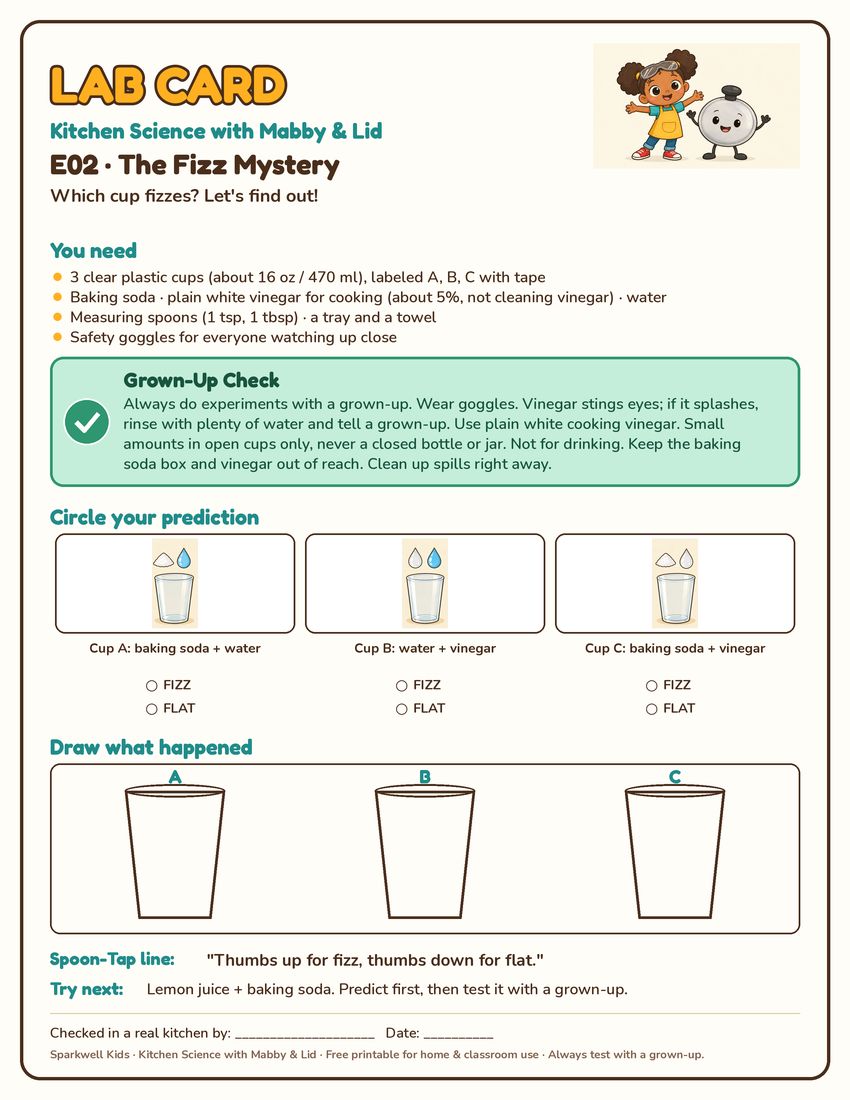
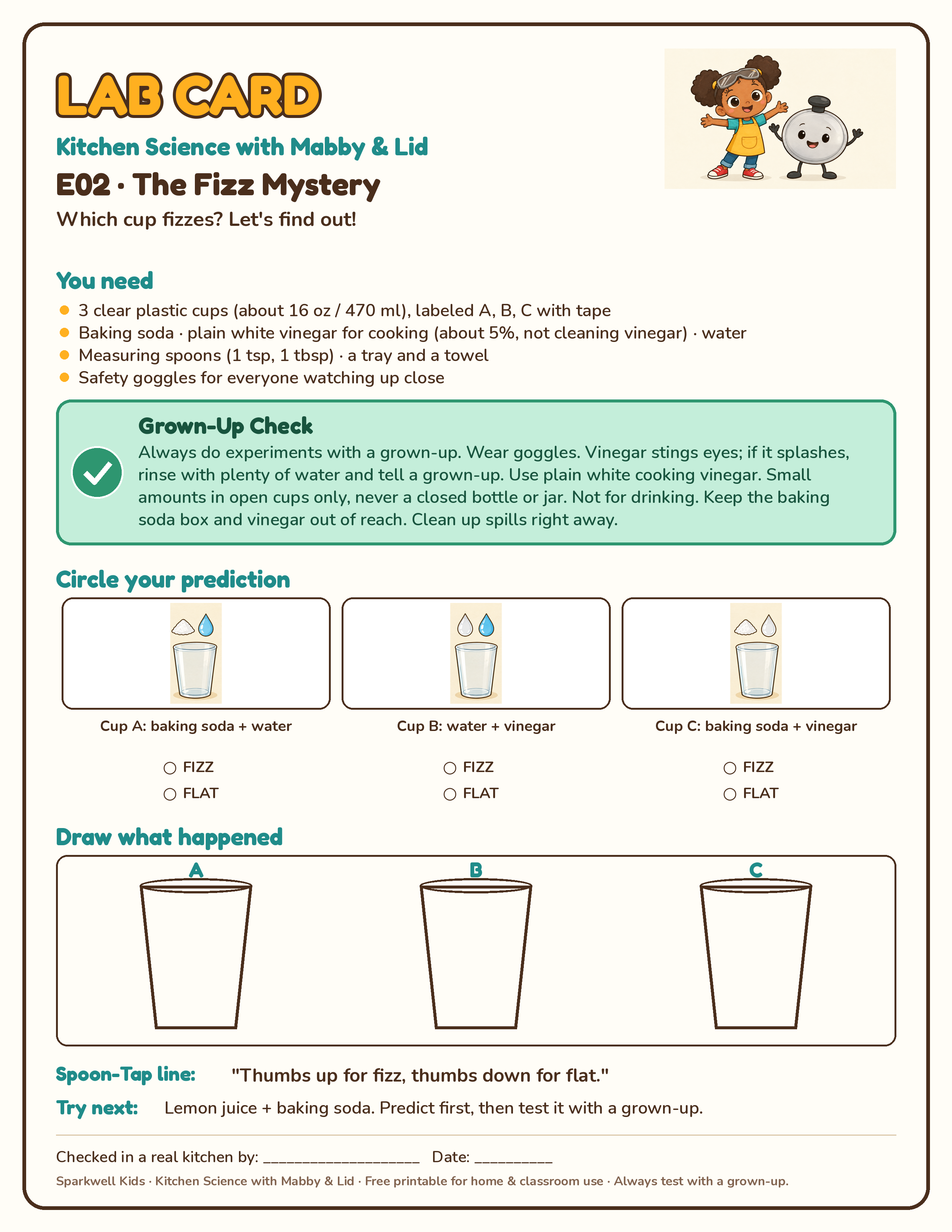
Preview of the E02 Lab Card, The Fizz Mystery: a one-page printable with a You need list, a Grown-Up Check box, a prediction to circle and a space to draw what happened.
Preview of the one-page card (US Letter).

Download PDF Full-size image

What you need

  • 3 clear plastic cups (about 16 oz / 470 ml), labeled A, B, C with tape
  • Baking soda · plain white vinegar for cooking (about 5%, not cleaning vinegar) · water
  • Measuring spoons (1 tsp, 1 tbsp) · a tray and a towel
  • Safety goggles for everyone watching up close

Grown-Up Check (from the card)

Always do experiments with a grown-up. Wear goggles. Vinegar stings eyes; if it splashes, rinse with plenty of water and tell a grown-up. Use plain white cooking vinegar. Small amounts in open cups only, never a closed bottle or jar. Not for drinking. Keep the baking soda box and vinegar out of reach. Clean up spills right away.

Also from the episode notes:

  • Wipe up spills. Vinegar makes floors slippery.

Prediction game (from the card)

Spoon-Tap Guess: "Thumbs up for fizz, thumbs down for flat." Then circle the prediction on the card.

Steps

  1. Put on goggles. Set the three cups on a tray and label them A, B, C.
  2. Cup A: 1 teaspoon baking soda, then 2 tablespoons water. Watch.
  3. Cup B: 1 teaspoon water, then 2 tablespoons vinegar. Watch.
  4. Cup C: 1 teaspoon baking soda, then 2 tablespoons vinegar, poured slowly. Watch.
  5. Which cups fizzed? Check your prediction.
  6. Pour everything down the sink with running water. Rinse the cups. Wipe the tray.

The science, for grown-ups

Baking soda and vinegar fizz only when they’re together. When they meet, they make something new: a gas called carbon dioxide, and the bubbles are that gas. Changing one thing per cup makes it a fair test.

Try next (on the card): Lemon juice + baking soda. Predict first, then test it with a grown-up. (Description: goggles on, small amounts, open cups, with a grown-up.)
E03 · Rainbow Bridge

The question: Can water climb? (Season 1, Episode 3)

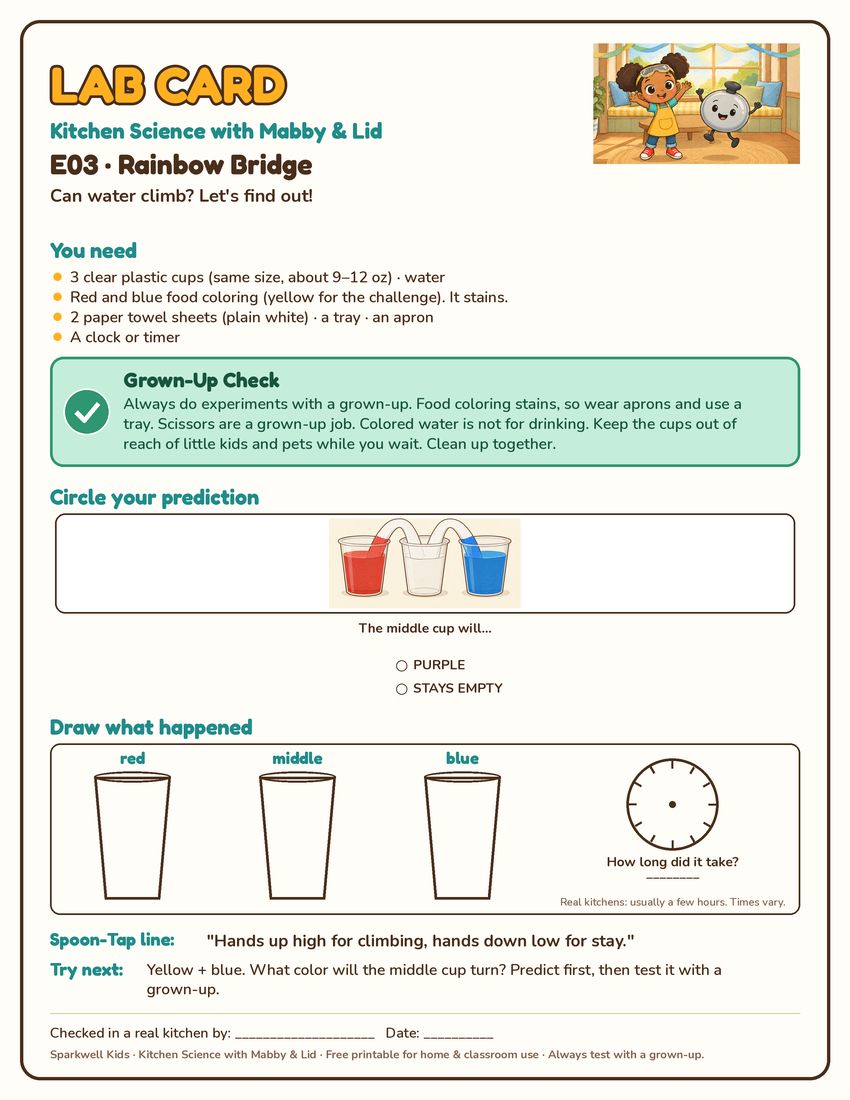
Preview of the E03 Lab Card, Rainbow Bridge: a one-page printable with a You need list, a Grown-Up Check box, a prediction to circle and a space to draw what happened.
Preview of the one-page card (US Letter).

Download PDF Full-size image

What you need

  • 3 clear plastic cups (same size, about 9–12 oz) · water
  • Red and blue food coloring (yellow for the challenge). It stains.
  • 2 paper towel sheets (plain white) · a tray · an apron
  • A clock or timer

Grown-Up Check (from the card)

Always do experiments with a grown-up. Food coloring stains, so wear aprons and use a tray. Scissors are a grown-up job. Colored water is not for drinking. Keep the cups out of reach of little kids and pets while you wait. Clean up together.

Also from the episode notes:

  • Challenge (yellow + blue): same setup and same safety steps.

Prediction game (from the card)

Spoon-Tap Guess: "Hands up high for climbing, hands down low for stay." Then circle the prediction on the card.

Steps

  1. Aprons on, tray down. Set three cups in a row.
  2. Fill the two outside cups about ¾ full of water. Add about 8–10 drops of red to one and blue to the other. Leave the middle cup empty.
  3. Fold a paper towel sheet lengthwise into a strip about 1 inch (2–3 cm) wide. Make two.
  4. Grown-up trims each strip so it can bend like a rainbow and reach the bottom of both cups.
  5. Put one strip from the red cup into the middle cup, and one from the blue cup into the middle cup.
  6. Quick test while you wait: dip just the corner of a paper towel into colored water. Watch it climb.
  7. Check the cups every 15–30 minutes. Write down the time. Keep the setup out of reach of little kids and pets while it sits.
  8. When the middle cup changes color, check your prediction. Pour everything down the sink and clean up together.

The full materials list in the episode plan also has a small plastic dish, an extra paper towel for the quick test, and kitchen scissors (grown-up only).

The science, for grown-ups

Water can climb through the tiny gaps in a paper towel. Scientists call it capillary action. When the red and blue water meet in the middle cup, they mix to make purple.

Try next (on the card): Yellow + blue. What color will the middle cup turn? Predict first, then test it with a grown-up.
How long did it take? (from the card): Real kitchens: usually a few hours. Times vary.

Printing tip: the PDFs are US Letter, one page each. Choose "Fit to page" for A4 paper.